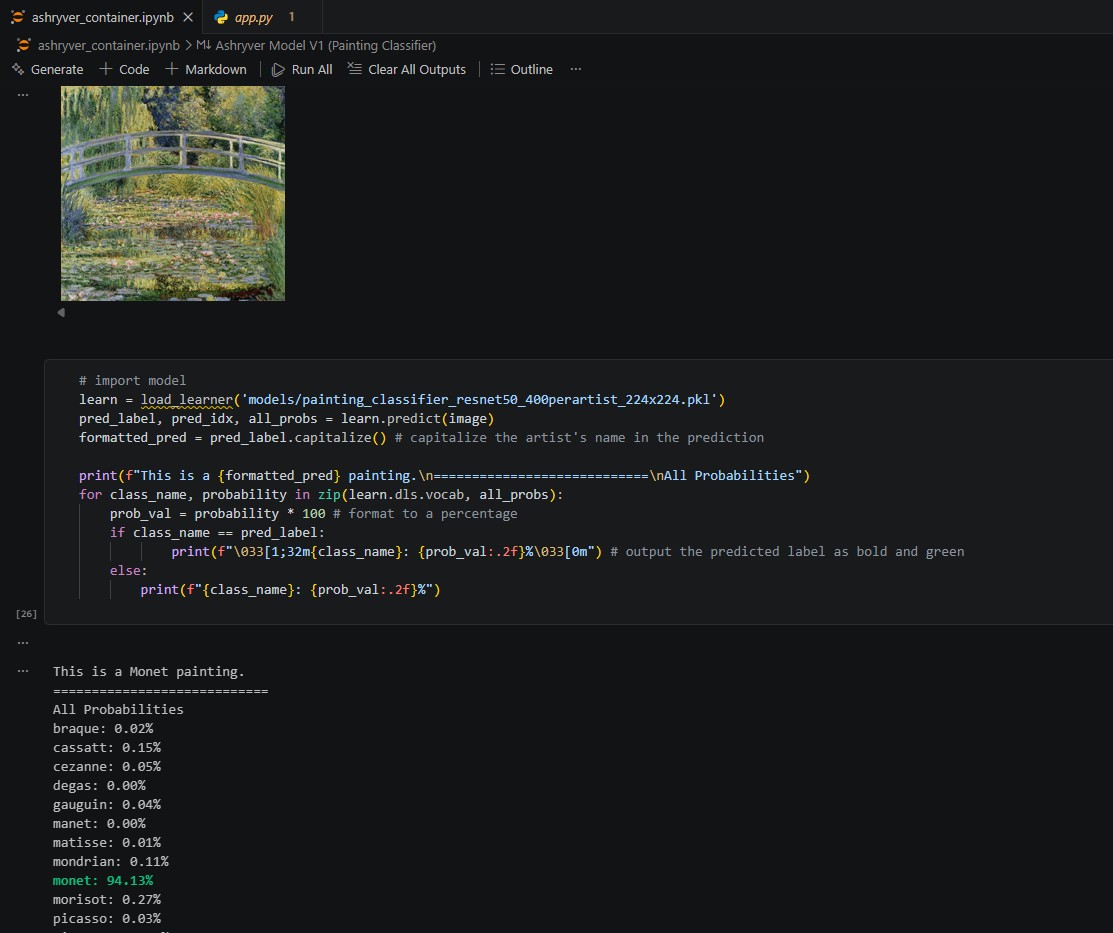
Today (and this entire week) has been quite the adventure when it comes to deep learning AI models. I finally got off the ground on my latest project, the Ashryver model (the easy-to-remember codename for the 20-artist painting classifier). After building it locally with Jupyter Notebooks and Kaggle, I advanced to the next unit in the fast.ai Practical Deep Learning course, and started attempting to deploy it on a HuggingFace/Gradio space…
…and promptly entered into a world of calamity.
Creating an account on HuggingFace and setting up a space was pretty easy. But that was just the tip of the iceberg, as you might imagine. After that I had to figure out a way to set up an API key, clone HuggingFace’s Github-adjacent-but-not-really-Github repository down to my computer, add my pickle files for the Ashryver model, and deal with all the humongous files and conflicts. This quickly spiraled into hell. First of all, the API keys kept getting “into a stuck state” when attempting to commit changes to HuggingFace; apparently HuggingFace had deprecated a core feature that allowed users to authenticate with their HuggingFace password back in 2023, and you now had to use your cryptic API key. So I was forced to generate the in-universe “aelin” API key and use that, which fortunately worked.
However, that wasn’t the end of the troubles. I then encountered issues committing any changes at all to HuggingFace, due to binary file limitations and Git LFS complications. At this point I was engaging in a lengthy back-and-forth conversation with Google Gemini, trying to figure out the best course of action for what I was facing. Every time I tried to turn on LFS or add the files, pushing any staged files would just lead to more and more errors. Eventually I just gave up and followed two core pieces of ML management advice: never upload your .PKL files or dataset files to source control because they can be a target for malware and bloat your repo. For now, I’m just leaving them untracked on my laptop, and not committing them to HuggingFace. After all, the model will be able to run live; users shouldn’t need to poke around in the source code this time.
Speaking of poking around in the source code and my future plans for the Ashryver architecture, let’s dig into those topics now…
Future Plans, Links, and Naming Conventions
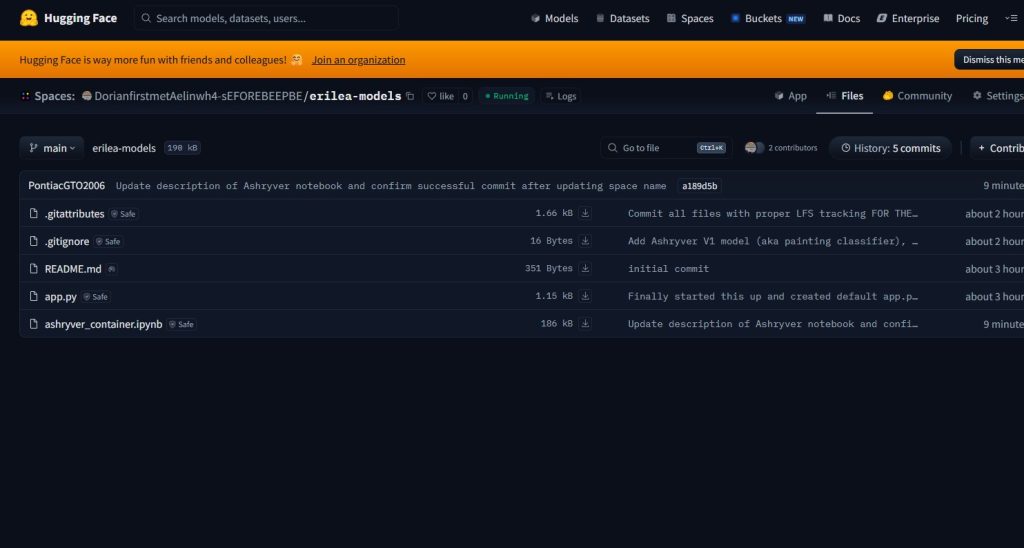
Click to view the current HuggingFace space, which is still very work-in-progress.
You may have noticed the rather unconventional name of the space itself, erilea-models, and the interesting name for the painting-classifier model architecture, Ashryver. If you’ve really been poking around in the Files section of the HuggingFace space, you may have noticed references to an “Aelin” or “Sam Cortland”. If you’re really receptive, you may have made the proper neural network connections and surmised that these are characters from a fictional series.
If so, congratulations. To make things more interesting, and detract from the tradition of naming repositories and models boring things “like Testing Area 1 and Deep Learning Architecture System Version 1”, I decided to spice things up and give this space and its models some creative names. These are not so much “original” as “easy-to-remember”, which makes it more convenient to key in GitHub commands when all your filenames and model names are simple names. I plan on naming each successive model I release after a different character, improving upon each one with clear version numbers.
As for my plans at the moment, I intend to continue working on getting the Ashryver V1 model into production. When that’s done, you’ll be able to go directly to that HuggingFace space (linked above), upload your own paintings, and have the model instantly make predictions. Right now, although the model has consistently been getting 0.89 accuracy on test runs, it still makes the occasional error when it comes to Henri Matisse’s paintings and tape drawings. This is an issue I plan to correct in Ashryver V2, which is where I might also introduce more artist categories. For now, though, all my time is probably going to be spent on getting Ashryver V1 into production.
What all this means is that users will no longer have to clone cumbersome GitHub repositories and figure out ways to get my code to work on their very different machine, which sounds like a recipe for disaster. I’m planning on uploading my past models into that same HuggingFace space as well, or maybe a different one to improve organization. I’ll at least put the CIFAR Image Classifier on there, and maybe even the QuickDraw model if I can get it to work. After that, I intend to work on some more computer vision models, deep learning projects, and put something even more substantive than Ashryver out on the web.
I’ll probably put up links to my various HuggingFace spaces eventually on this website, and they will serve as the “showcase sites” or portfolio pieces for the various AI models. This is what I’ve been working up to for quite a while, and it’s good that I’ve finally started working on a way to get these models into production.
Well, that’s all for now on the deep learning front. Stay tuned for more calamitous updates!
Leave a Reply