It’s been a little while since the last update on this site, but then again, I’ve been quite preoccupied with various projects ever since the downfall of the Ashryver Models situation. (That’s right: the Ashryver V1 painting classifier and everything related to it has now been destroyed, and no longer works. This is the result of a full-scale pivot to more reliable, worthwile, and engaging projects). I’m now mainly focusing on the final main book in the Flames of Rebellion Series, and a Blender 3D modeling project for a BeamNG.drive mod.
In this update, it’s time to take a look at what’s been going on lately. I’ll also provide some rough estimates and plans for the Flames of Rebellion series, and when the next couple of books might be coming out.
Blender 3D Modeling: the Soluna Project
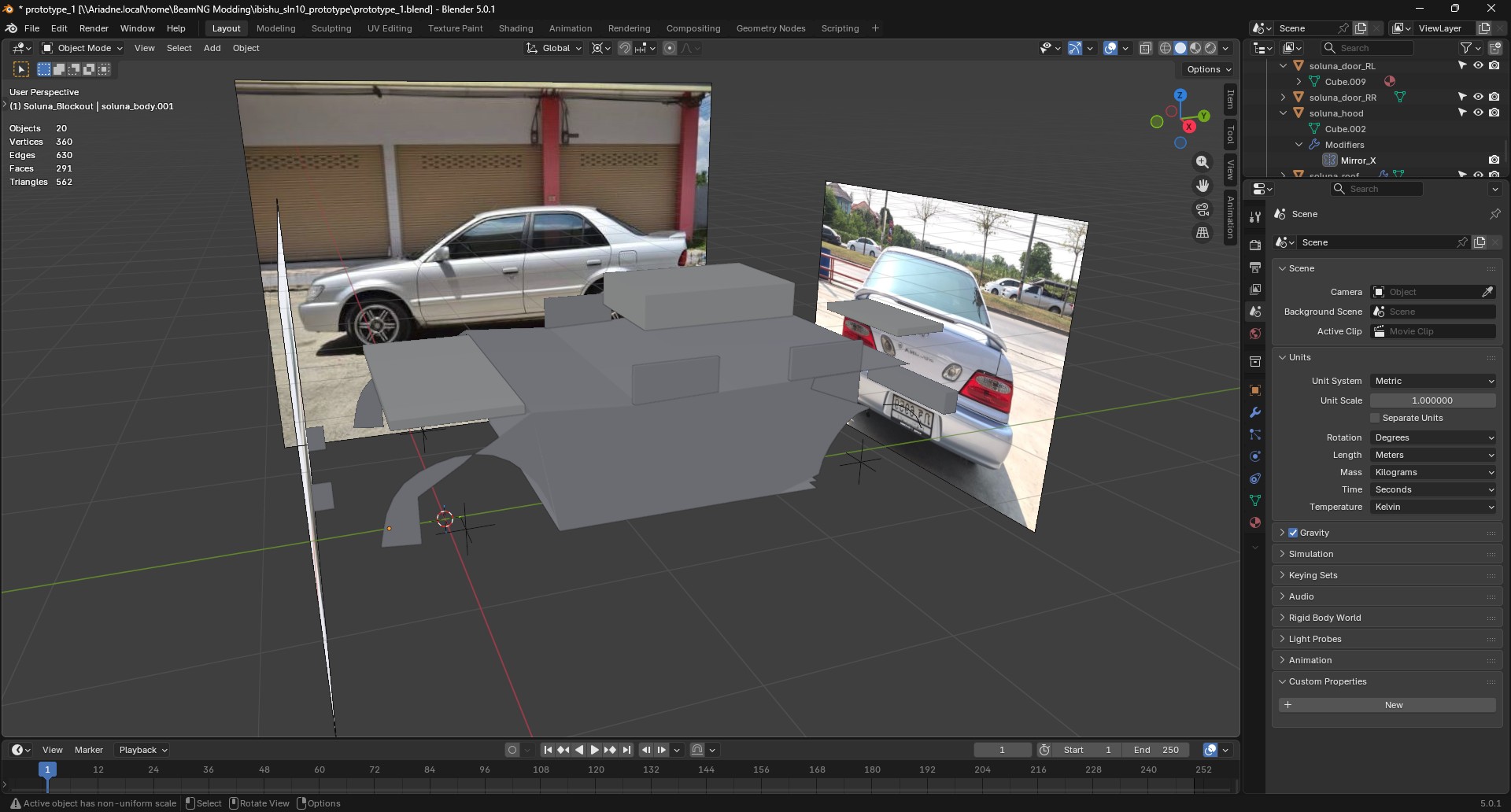
This is my latest (and primary) undertaking. I started working on this 3D modeling project about three weeks ago, and it was inspired by the lack of any AL50 Toyota Soluna (1998-2002) mods on the BeamNG.drive community. This is because it’s not a very well-known vehicle; with this project, I intend to fill that gap.
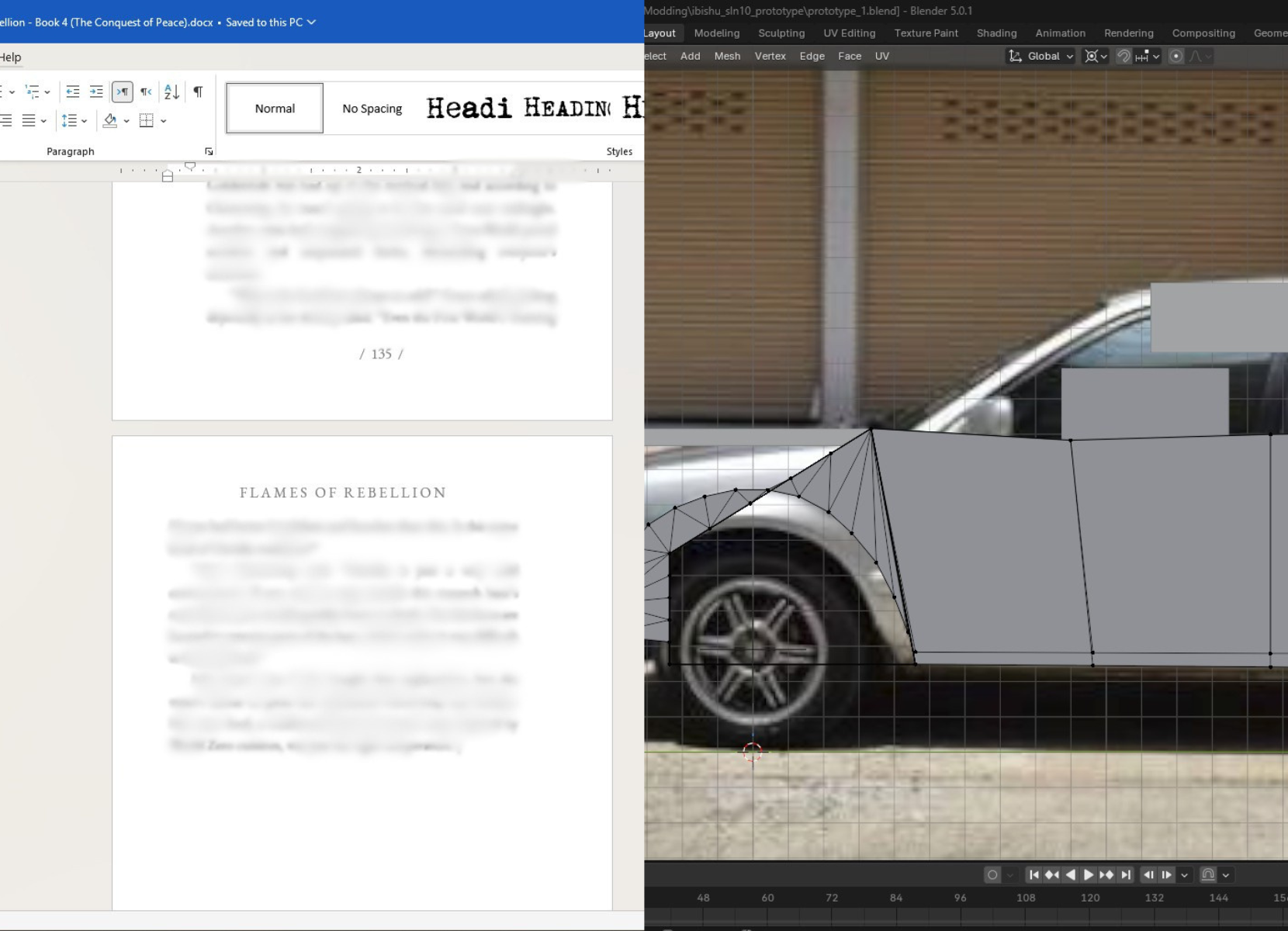
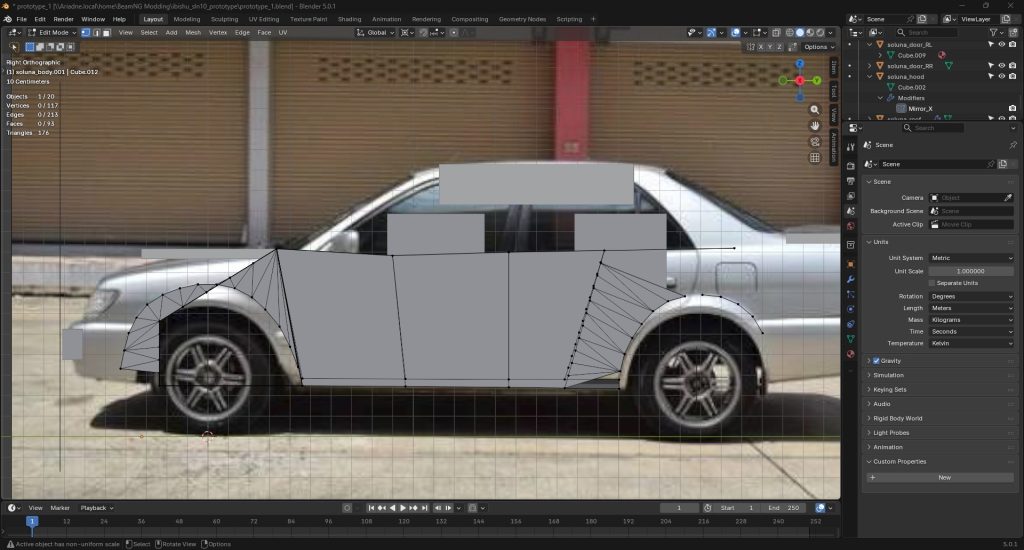
My first step in this project will obviously be to get a basic 3D model. This is proving to be a very challenging and time-consuming process; however, I have completed the body outline, all four wheel arches, and now starting on shaping the hood after three weeks. My current estimate is that it’ll take another few months to get this model done if I continue working at this pace; December or January of next year is a good estimate.
After that, I’ll need to move into the nodes & beams phase of the modeling process. This involves using the 3D model as a framework and adding the BeamNG core components around it, including the nodes, which are like the vertices in a complex chemical structure, and the beams, which connect the nodes together. There could easily be thousands of nodes and beams for a fully beamed (or JBEAMED) vehicle, so this might take another 4-5 months.
The final phase will likely involve doing some UV mapping, sorting out the myriad bugs that I’m sure will emerge, and getting all the configurations set up. And this will likely just be for the basic Soluna copy with the standard interior and openable doors. This particular version of the project will be released on third-party sites like Modland only, since BeamNG prohibits the distribution of copyrighted vehicles on their own site.
However, I have a workaround for that. Once I’m satisfied with the base Soluna mod, my intention is to go back and creatively modify the vehicle so that it fits with BeamNG’s in-game Ibishu brand. This should work well, since Ibishu is BeamNG’s equivalent of Toyota; from there, I can subtly change the taillight design and the gauge cluster, for example, so that I can market a lore-friendly Soluna version on the BeamNG repository. (This whole mod will obviously be free, of course. I don’t believe in charging money for mods of any kind, no matter how many apps are supported by the game’s ‘CarPlay’ screen, or how many ‘hours per day’ I spend on the mod).
Right now, all of this is sounding rather daunting as I’m only on the 3D modeling stage. Honestly, though, I’ve made a whole lot more progress than I’ve expected in the psat few weeks–and certainly since the first blog post I wrote about this modeling project, when the Soluna was still a shapeless box. I’ve encountered numerous troubles along the way, most notably with the wheel arches. For some reason the geometry got destroyed as I was trying to fill in points surrounding the rear arch; the fan got all tangled up and cluttered. I had to completely reset the rear arch and start over; fortunately, that fixed the problem after a couple days’ of work. I can only hope that I’ll be able to push through similar challenges as this gets more complex, becuase I know these issues will be coming.
Below is another view of the current state of the Soluna project; I’ve just diagnosed an issue with the main soluna_body being far too narrow. Hopefully I haven’t inadvertently broken anything else.
Flames of Rebellion Book 4
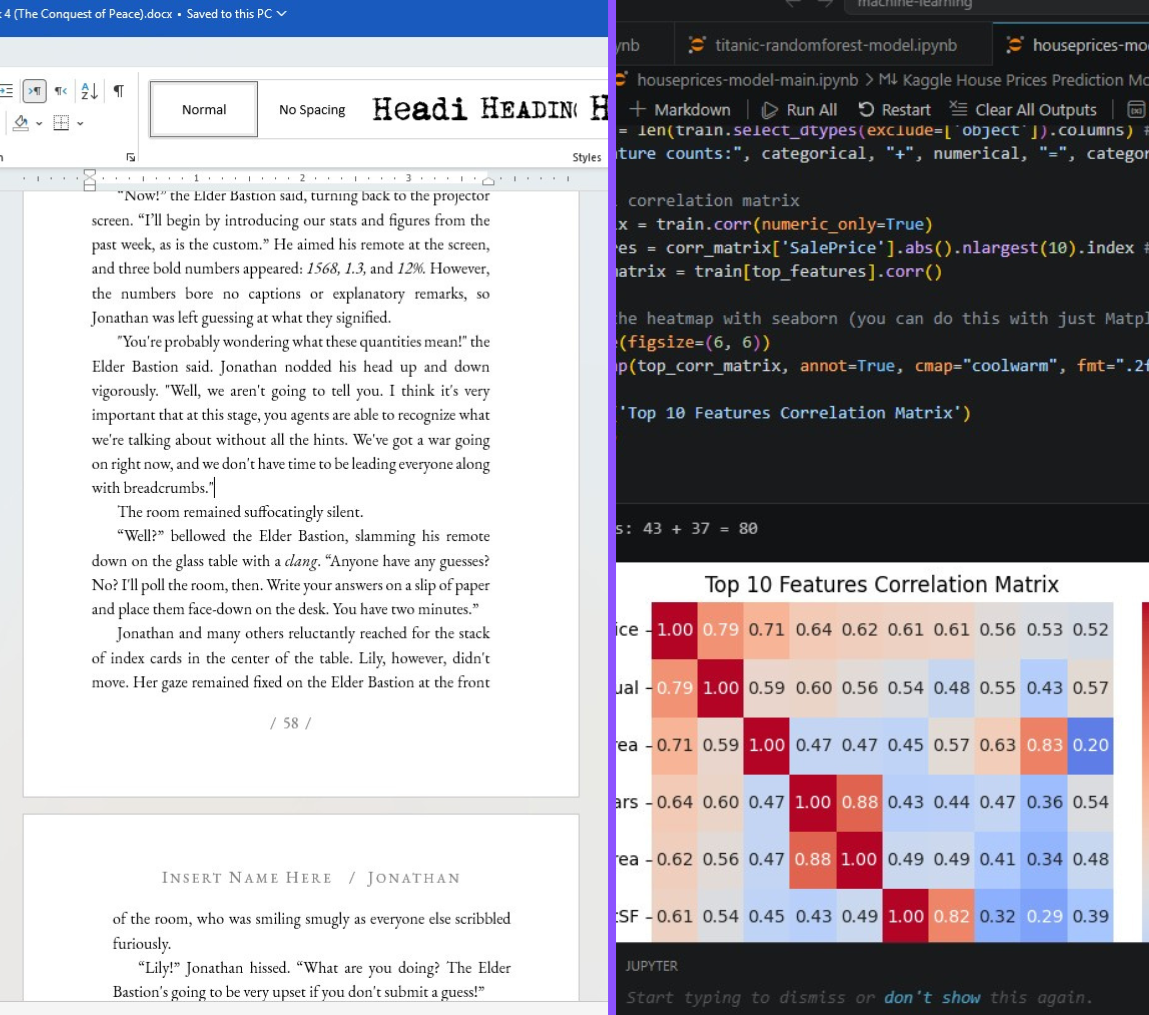
As you may recall, the previous book in the Flames of Rebellion series (book 3.5) was published just back in April. That was Reckoning of the Past, a medium-length in-between novel detailing a side plot in the series. Now, I’m moving hard on Book 4 in the Flames of Rebellion series, currently called The Conquest of Peace. This will likely be a longer book, in the 410-420 page range, as this is the series finale and needs to tie up all the loose plot ends. Right now, I’m sitting at about 30,000 words and 135 pages, putting me at about 35% through the book. I can’t release a target month right now, as it’s still a bit too early for that, but I’m hoping it can be published around winter 2026 (December 2026 to maybe January 2027).
After that, only one book will be left: the prequel. This will be book 0.5, examining what came before the First World and the Thirteen Worlds and everything taking place in the main series. Book 0.5 will be set in around GY 23, which is the World Zero equivalent of about seven hundred years prior to the main novels. It will focus on the ancient Cymantian Empire, explaining the political conflicts and conquests that split apart the empire and led to the turbulent formation of the First World. While Jonathan, Lily, Phoenix, Ember, and Grace will not be a part of the prequel (at least, not right now), there will be many other new and intriguing characters, plus old villains like Aaron Fisker and the Cymantus itself. I’m still figuring out the best way to introduce this ancient world without making readers feel too confused.
My current end-of-series target is summer 2027, or about a year from now. If possible, I’d like to get the Flames of Rebellion universe closed out before the next International-Offshore Excursion, which is still tentatively set for summer 2027 as well. This will provide clean break for the next project, which might be something completely different, and much more grounded in reality. Stay tuned for that.
Well, with that, I think that’s everything for this site update. I’ll be updating the Flames of Rebellion page soon with some more details about Book 4, and expect more updates as the Blender 3D modeling project progresses. Hopefully I won’t destroy any more geometry!